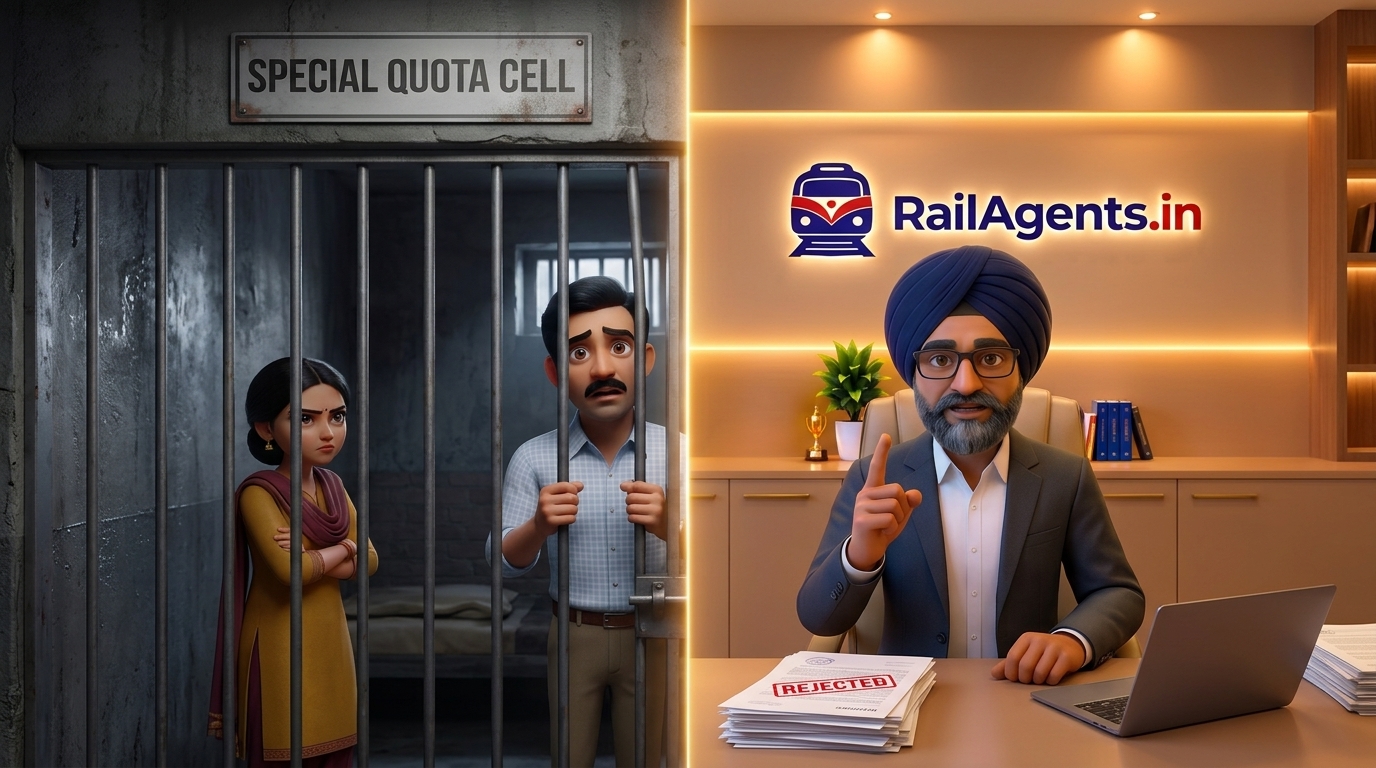
Are you relying on touts or fake VIP/Emergency Quotas (EQ) to confirm waitlisted train tickets? Learn about Indian Railways' strict laws and how one mistake can put passengers behind bars and permanently cancel a travel agent's IRCTC license.
Overview: The Hidden Trap Behind “Guaranteed” Waitlist Confirmations
Getting a confirmed train ticket during peak festive rush, summer vacations, or wedding seasons in India feels nothing short of winning a battle. When passengers are stuck with a high-waitlisted (WL) ticket and traveling is an absolute necessity, desperation sets in. People begin searching for any possible backdoor to secure a confirmed berth.
Taking advantage of this urgency are fraudulent touts, WhatsApp/Telegram brokers, and unauthorized middlemen who claim to guarantee 100% ticket confirmation through the “VIP Quota” (officially known as the Emergency Quota or HO/Headquarters Quota) in exchange for ₹1,000 to ₹3,000 per passenger.
Sometimes, due to a lack of legal awareness or the temptation of earning a small extra margin, even legitimate Rail Travel Agents (RSPs) fall into the trap of these middlemen and hand over their customers’ PNR numbers. However, few realize just how devastating—and criminal—the consequences of this shortcut can be.
Let’s break down how the fake VIP/EQ quota scam operates, how Railway Vigilance catches offenders in real time, and who bears the brunt of the law when caught.
1. What Exactly is the VIP or Emergency Quota (EQ) in Indian Railways?
In Indian Railways, a limited number of berths across different classes (1A, 2A, 3A, CC, and SL) in almost every mail/express train are earmarked under the Emergency Quota (EQ)—commonly referred to by the public as the “VIP Quota” or “HO (Head Office) Quota.”
Who is Legally Eligible for Emergency Quota?
This quota is strictly regulated and reserved for specific high-priority categories prior to chart preparation:
- High Constitutional & Government Dignitaries: Cabinet Ministers, Supreme Court & High Court Judges, Members of Parliament (MPs), and Members of Legislative Assemblies (MLAs).
- Senior Bureaucrats & Railway Officials: Senior central/state government officers traveling on urgent official duty.
- Critical Passenger Emergencies: Regular passengers facing verifiable life-or-death medical emergencies (such as cancer treatment, organ transplant, or bereavement), senior citizens in distress, or national-level athletes/students traveling for scheduled government examinations or interviews.
How Legitimate EQ Allotment Works:
- Warranted Written Request: To release a berth under EQ, an official written requisition on an authentic Official Letterhead (or a prescribed EQ form supported by hospital/official proof) signed by an authorized gazetted officer or public representative must be submitted to the Divisional/Zonal Railway EQ Cell before chart preparation.
- Zero Commercial Sale: Emergency Quota berths cannot be bought or sold for a fee. No private broker or travel agent has an “official tie-up” to purchase EQ seats.
2. How Market Touts Execute the Forged Letterhead Fraud
Fraudulent touts operating around major railway stations or on social media groups have no genuine connection to MPs, MLAs, ministries, or senior railway officers. Instead, their modus operandi relies on blatant document forgery:
- Collecting Waitlisted PNRs & Cash: When a desperate passenger or a misled travel agent pays ₹1,000–₹2,500 along with a waitlisted PNR, the tout promises “guaranteed confirmation at charting.”
- Desktop Forgery: Using graphic design software, laser printers, and counterfeit rubber stamps, the tout fabricates a fake recommendation letter purporting to be from a Member of Parliament, a Ministry Secretariat, or a senior IPS/IAS officer.
- Forged Signatures & Drop-Box Submission: The tout forges the dignitary’s signature, enters the passenger’s PNR and travel details as a “close relative” or “personal staff,” and slips the forged letter into the Railway EQ Cell drop-box or sends it via fax/email.
How Railway Vigilance Catches the Scam Instantly:
Indian Railways has modernized its Emergency Quota verification workflow. Today, the Railway Vigilance Department and Commercial EQ Cells cross-verify requisitions directly with the offices of MPs, MLAs, and ministries via dedicated phone lines, unique serial codes, and digital registries.
The moment a letterhead or signature fails verification:
- The PNR is immediately red-flagged in the PRS/CRIS database.
- Sometimes the seat is intentionally allotted or tracked so the beneficiary can be identified onboard.
- A high-priority alert is dispatched to the onboard Travelling Ticket Examiner (TTE), the Railway Protection Force (RPF), and the Government Railway Police (GRP) at the boarding or next major halting station.
3. “Your Name on the Ticket, Your Punishment!” – Why the Passenger Goes Straight to Lockup
When RPF/GRP personnel and Vigilance officers confront the passenger onboard the train during ticket checking, the passenger’s immediate defense is almost always the same:
“Sir, I know nothing about a fake MP letterhead! I just paid an agent extra money to get my waitlisted ticket confirmed!”
However, Indian railway regulations and criminal jurisprudence leave zero room for this excuse:
- Presumption of Direct Beneficiary: Because the ticket bears the passenger’s full name, age, ID card number, and registered mobile number—and the passenger is physically occupying the berth released via the forged document—the law treats the passenger as the primary beneficiary and abettor of the crime.
- Immediate Deboarding & Detention: The passenger (along with accompanying family members on the same PNR) is deboarded at the next station and handed over to the GRP/RPF.
- Non-Bailable Criminal Sections: An FIR is registered under severe provisions of the Bharatiya Nyaya Sanhita (BNS) / Indian Penal Code (IPC) for cheating, forgery of valuable security/government documents, using a forged document as genuine, and criminal conspiracy, alongside provisions of the Railways Act, 1989.
- Vacation Turns into Court Dates: Instead of reaching their destination, families find themselves detained in a railway police lockup, hiring criminal defense lawyers, and attending court hearings in a distant state for years.
4. The Biggest Warning for Authorized Rail Travel Agents (RSPs)!
If you are an Authorized IRCTC Rail Travel Service Agent (RSP), handing over a customer’s waitlisted PNR to an unauthorized middleman for “VIP Quota confirmation” is nothing short of professional suicide.
Here is the exact chain of events that unfolds when your customer is detained onboard by the Railway Vigilance team:
- The Customer Will Name You Immediately: To save themselves from jail, the detained passenger will immediately show the police their WhatsApp chat, call logs, and UPI payment screenshot sent to your travel agency.
- The Tout Will Vanish Into Thin Air: The broker who took ₹1,500 from you will immediately switch off their phone, destroy the SIM card, and disappear. Touts operate on mule accounts and fake identities—they have no registered shop or license to lose.
- RPF & Police Raid on Your Agency: Armed with the passenger’s statement and digital payment trail, the RPF/GRP cyber and vigilance wing will trace the transaction straight to your shop premises, seizing your computers, mobile phones, and registers.
- Permanent Blacklisting of Your IRCTC License: The moment an authorized agent’s name surfaces in an EQ forgery or touting investigation, IRCTC and the Principal Service Provider (PSP) immediately suspend and permanently blacklist your RSP Agent ID, forfeiting your security deposit.
- Prosecution Under Section 143 of the Railways Act & Forgery Laws: You will be booked as a co-accused conspirator in forging government documents and unauthorized procurement of railway accommodation—carrying up to 3 to 7 years of imprisonment and heavy fines. Years of hard-earned market goodwill vanish overnight.
5. Comparison: Fake VIP Quota Shortcut vs. Legal IRCTC Alternatives
| Method | Legality | Risk to Passenger | Risk to Travel Agent |
|---|---|---|---|
| Fake VIP / HO Quota via Touts | 100% Illegal & Criminal Offense | Immediate deboarding, FIR, arrest & court trial | Permanent IRCTC ID cancellation, shop raid & jail |
| Official Tatkal & Premium Tatkal Quota | 100% Legal (Opens 1 day prior to journey) | Zero risk; fully valid confirmed/RAC ticket | Safe when booked within official RSP Tatkal timings |
| Vikalp Scheme (Alternate Train Accommodation) | 100% Legal & Free IRCTC Feature | Zero risk; shifts WL passengers to alternate trains with vacant berths | Builds high customer appreciation at ₹0 extra cost |
| Multi-Modal or Break-Journey Booking | 100% Legal | Zero risk; combines confirmed segments, flights, or luxury AC buses | Earns legitimate extra commission across multiple bookings |
6. Golden Rules: How to Be a Smart, Safe, and Profitable Rail Travel Agent
The true capital of a successful travel agency is customer trust and a clean, active IRCTC license. Follow these four non-negotiable rules to protect your livelihood:
- Say a Firm “NO” to Illegal Shortcuts: No matter how much pressure a client puts on you or how much extra service charge they offer, never share a PNR with unknown brokers or Telegram/WhatsApp groups promising HO/VIP quota confirmations.
- Offer Legitimate Alternatives Proactively: When a regular train is heavily waitlisted, guide your customer toward legal solutions—such as opting for the Vikalp Scheme, booking in Special Festival Trains, checking Current Reservation (CURR_AVBL) after chart preparation, or combining train + flight/bus routes.
- Educate Your Customers Openly: If a customer mentions that “another agent promised to confirm my ticket via VIP quota for ₹2,000,” warn them about the forged letterhead trap and RPF crackdowns. Even if they don’t book immediately, your honesty will double their respect and long-term loyalty toward your agency.
- Book Strictly Through Official B2B Portals: Always conduct 100% of your railway bookings through your authorized IRCTC B2B RSP terminal in strict compliance with Indian Railways commercial circulars.
Frequently Asked Questions (FAQs)
Q1. Can a genuine passenger apply for the Emergency Quota (EQ) legally?
Yes. If a passenger has a genuine medical emergency, bereavement, or urgent official duty, they can personally submit an application along with valid supporting documents (such as hospital referral papers or official government orders) at the Divisional/Station EQ Cell or through an authorized constitutional dignitary whom they personally know—without paying any middleman.
Q2. What happens if a waitlisted ticket confirmed through a tout is caught during the journey?
The ticket is treated as invalid/fraudulently obtained, the passenger is deboarded at the next station, and an FIR is registered by the RPF/GRP against both the passenger and the agent/broker involved in submitting the forged EQ request.
Q3. Can an IRCTC agent ever get their license back after being blacklisted in a quota fraud case?
No. Involvement in touting, Section 143 offenses, or forged EQ requisitions results in permanent PAN-based blacklisting across all IRCTC Principal Service Providers (PSPs).
Conclusion: Protect Your Reputation—Say No to Quota Scams
Never gamble away years of hard-earned reputation, your family’s peace of mind, and the future of your travel agency for a ₹500 or ₹1,000 cut. Work with integrity, transparency, and accurate regulatory knowledge—because only a compliant and ethical agent rules the market in the long run!
Are you a travel agent looking to safeguard your agency while growing your business legally?
For accurate updates on Indian Railways rules, authorized IRCTC agent registration, and reliable B2B travel guidance, connect with RailAgents.in today!
Watch & Connect on Social Media
Follow this topic on our official social channels
Have questions about IRCTC authorized agent rules, ID onboarding, or compliant railway ticket booking operations? Our team helps travel businesses stay updated and compliant.