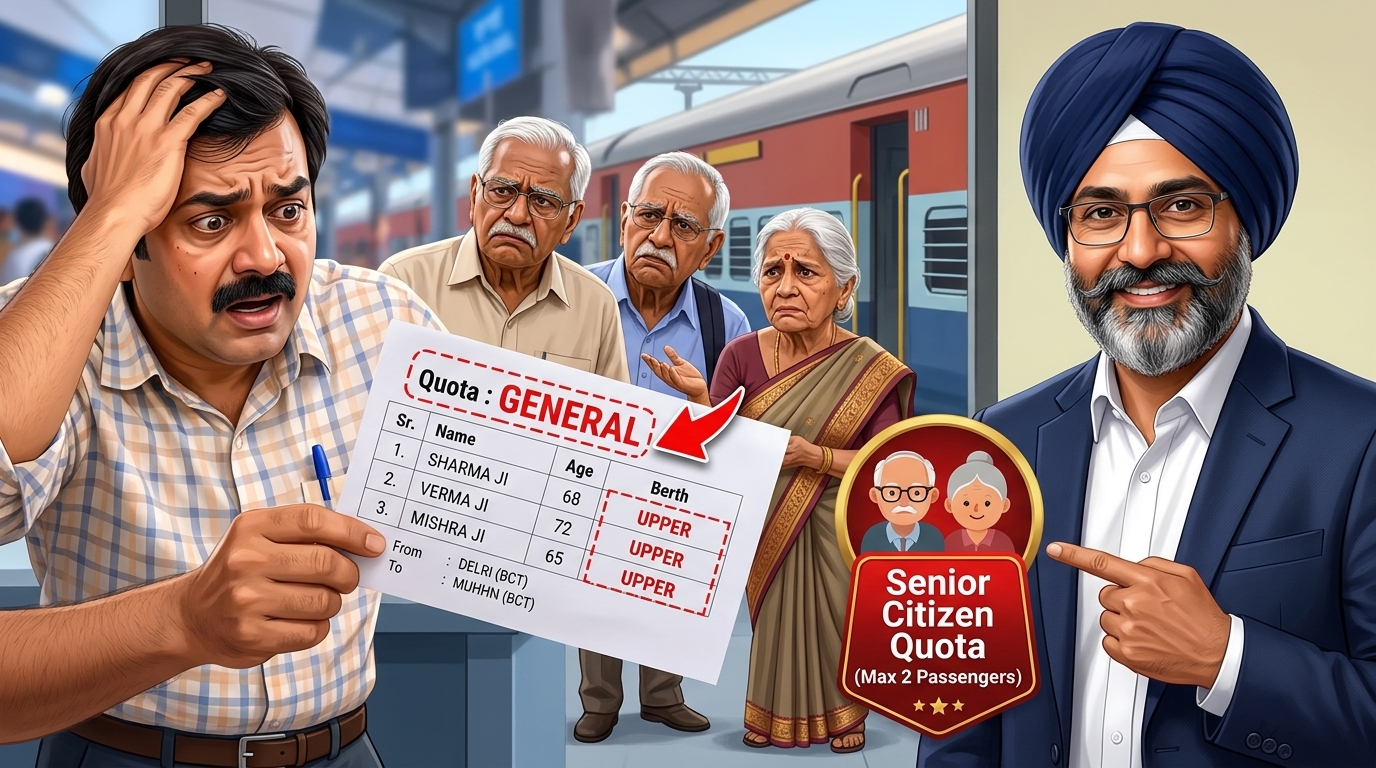
Complete guide to Indian Railways Senior Citizen / Lower Berth Quota (SS). Learn age eligibility for male and female passengers, maximum passenger limits per PNR, coach-wise reserved berths, and how to guarantee a confirmed Lower Berth.
Overview: Understanding the Senior Citizen Quota in Indian Railways
For elderly passengers, climbing up to a Middle or Upper Berth in a moving train is both uncomfortable and unsafe. To ensure convenient and accessible rail travel, Indian Railways provides a dedicated reservation pool known as the Lower Berth Quota (officially coded as “SS”), commonly referred to as the Senior Citizen Quota.
However, many passengers and even rail ticketing agents end up getting allotted Upper or Middle Berths despite entering the passenger’s senior age on the booking form. This happens because Indian Railways enforces strict system rules regarding quota selection, passenger count per PNR, and mixed-age bookings.
Here is the complete, updated guide covering what the Senior Citizen Quota is, who can use it, how many seats are reserved per coach, and the exact rules to get a confirmed Lower Berth every time.
1. What is the Senior Citizen / Lower Berth Quota (SS Quota)?
The Lower Berth Quota (SS) is a special reservation quota in Indian Railways under which a fixed number of Lower Berths in reserved coaches are earmarked exclusively for senior citizens and eligible female passengers.
Unlike the General Quota (GN)—where the computer allots Lower, Middle, Upper, Side Lower, or Side Upper berths based on overall coach availability—tickets booked under the Senior Citizen Quota (SS) allot only confirmed Lower Berths as long as seats are available in that pool.
2. Who is Eligible to Book Under the Senior Citizen Quota?
Indian Railways defines clear age and category criteria to qualify for the Lower Berth / Senior Citizen Quota (SS):
Male Senior Citizens: Men aged 60 years and above on the date of the journey.
Female Passengers (45+ Category): Women aged 45 years and above on the date of the journey (even though the standard senior citizen age is 58/60, Indian Railways permits women aged 45+ to book under the Lower Berth Quota).
Pregnant Women: Expectant mothers (primarily through PRS counter reservation upon producing a valid medical certificate from a registered practitioner; online rules require meeting the standard age validation).
Important Note on ID Proof: Passengers travelling on a berth allotted under the Senior Citizen Quota must carry a valid government photo ID (such as Aadhaar Card, Voter ID, PAN Card, or Passport) verifying their date of birth/age during the journey.
3. How Many Lower Berths Are Reserved per Coach Under SS Quota?
In almost all Mail, Express, Superfast, and Rajdhani/Shatabdi-type trains with sleeping accommodation, Indian Railways earmarks a dedicated number of Lower Berths per coach under the SS Quota:
Class of Travel | Class Code | Reserved Lower Berths per Coach (SS Quota) |
|---|---|---|
Sleeper Class | SL | 6 to 7 Lower Berths per coach |
AC 3-Tier / AC 3-Economy | 3A / 3E | 4 to 5 Lower Berths per coach |
AC 2-Tier | 2A | 3 to 4 Lower Berths per coach |
Note: The Senior Citizen Quota is not applicable in AC First Class (1A) or chair-car sitting classes (CC, EC, 2S) since sitting coaches do not have sleeping berths.
4. Mandatory Booking Rules & PNR Restrictions (Why Passengers Get Upper Berths by Mistake)
To successfully book a ticket under the Senior Citizen Quota, the IRCTC / PRS reservation system enforces strict automated validations. Failing even one of these conditions causes the booking to fail or shift to the General Quota (GN)—resulting in Upper or Middle Berths:
Rule 1: Maximum 2 Passengers Allowed per PNR
Under the Senior Citizen / Lower Berth Quota (SS), you can book for a maximum of ONLY 2 eligible passengers on a single PNR (travelling alone or two eligible passengers travelling together).
If you add 3, 4, or more senior citizens on a single ticket, the reservation system will not allow booking under the Senior Citizen Quota.
If the ticket is then booked under the General Quota with 3+ passengers, the system treats it as a regular booking and frequently allots Upper or Middle Berths.
Rule 2: No Mixing of Non-Eligible Younger Passengers on the Same PNR
Every passenger listed on a Senior Citizen Quota PNR must individually meet the age criteria (Male 60+ or Female 45+).
If a 65-year-old parent and a 32-year-old son/daughter are entered on the same booking form, the system disqualifies the ticket from the SS Quota.
Correct Solution: Always book the eligible senior citizen(s) on a separate PNR under the SS Quota, and book the younger accompanying family members on another PNR under the General Quota.
Rule 3: Explicit Quota Selection is Mandatory
Simply entering age 65+ and selecting “Lower” as a berth preference under the General Quota (GN) does not use the reserved Senior Citizen pool. While the IRCTC algorithm gives priority to senior citizens in General Quota if lower berths are open, it will still allot an Upper Berth if regular lower berths are full. You must explicitly select “LOWER BERTH / SR. CITIZEN (SS)” from the Quota dropdown before searching for availability.
Rule 4: Confirmed Berths Only (No RAC or Waitlist in SS Quota)
Tickets under the SS Quota are issued only up to the exact number of earmarked Lower Berths available. Once the SS Quota seats in a train are filled, the status displays NOT AVAILABLE or REGRET (there is no Waitlist or RAC under the SS Quota).
5. Comparison: Senior Citizen Quota (SS) vs. General Quota (GN)
Feature / Rule | Senior Citizen / Lower Berth Quota (SS) | General Quota (GN) |
|---|---|---|
Target Passengers | Males 60+ yrs & Females 45+ yrs only | All passengers of any age |
Max Passengers per PNR | Maximum 2 eligible passengers | Up to 6 passengers per PNR |
Lower Berth Guarantee | 100% Guaranteed Lower Berth if available | Subject to availability; may allot Upper/Middle berth |
Mixed Age Booking | Not Permitted on the same PNR | Permitted |
Waitlist / RAC Facility | No Waitlist/RAC (Confirmed Lower Berths only) | Confirmed, RAC, and Waitlist available |
6. Step-by-Step Guide: How to Book a Guaranteed Lower Berth Correctly
Whether you are a passenger or an Authorized IRCTC Rail Travel Agent (RSP), follow these steps to ensure elderly travellers always get Lower Berths:
Select the Correct Quota First: On the train search screen, change the Quota dropdown from
GENERALtoLOWER BERTH / SR. CITIZEN.Check Availability: Look for trains showing
AVAILABLEunder the Senior Citizen Quota. Every available seat here is a dedicated Lower Berth.Split Larger Groups into Pairs: If 3 or 4 senior citizens are travelling together, divide them into separate tickets of maximum 2 passengers per PNR so every ticket qualifies for the SS Quota.
Use Conditional Booking When Booking in General Quota: If the Senior Citizen Quota is already full and you must book under the General Quota, always tick the checkbox: “Book only if at least 1 (or 2) lower berth is allotted.” If a Lower Berth is not available at payment time, the ticket will not be booked and your money will be refunded automatically.
7. What About the Senior Citizen Fare Concession (Discount)?
Many travellers confuse the Senior Citizen Seat Quota (SS) with the Senior Citizen Fare Discount:
Fare Concession Status: The 40% (male) and 50% (female) ticket fare discount for senior citizens, which was suspended by Indian Railways in March 2020, remains suspended across regular train classes.
Lower Berth Quota Status: The Lower Berth reservation facility (SS Quota) is 100% active. Eligible senior citizens pay the standard adult ticket fare but receive priority confirmed Lower Berths from the reserved quota pool.
Frequently Asked Questions (FAQs)
Q1. Why did the quota automatically change from Senior Citizen to General during booking?
The IRCTC system restricts or switches the quota to General if you enter more than 2 passengers on a single PNR, or if even one passenger on the form is below the required age limit (Male < 60 years or Female < 45 years).
Q2. Can a 62-year-old man and his 56-year-old wife book together under the Senior Citizen Quota?
Yes! Since the minimum eligibility age under the Lower Berth / Senior Citizen Quota is 60 years for males and 45 years for females, both qualify individually and can book 2 confirmed Lower Berths together on a single PNR.
Q3. What if a senior citizen already has an Upper Berth on a confirmed ticket?
After boarding the train, the senior citizen can request the onboard Travelling Ticket Examiner (TTE) for a berth exchange. Under Indian Railways commercial circulars, TTEs are authorized to allot any vacant Lower Berths (arising from no-shows after chart preparation) on a priority basis to senior citizens, pregnant women, and PwD passengers.
Conclusion
Understanding the difference between selecting a “Lower Berth preference” in General Quota and booking under the dedicated Senior Citizen / Lower Berth Quota (SS) saves elderly passengers from physical hardship and protects travel agents from costly booking disputes. Always remember the golden rule: select the SS Quota explicitly, keep a maximum of 2 eligible passengers per PNR, and use conditional lower-berth filters whenever booking in General Quota.
Looking for more official Indian Railways rules, fare calculators, and IRCTC agent guides?
Explore RailAgents.in for verified railway updates and professional travel agent resources!
Watch & Connect on Social Media
Follow this topic on our official social channels
Have questions about IRCTC authorized agent rules, ID onboarding, or compliant railway ticket booking operations? Our team helps travel businesses stay updated and compliant.